FabFilter Pro-Q 4 Is Here: What the New Dynamic EQ Does for Vocal Mixes
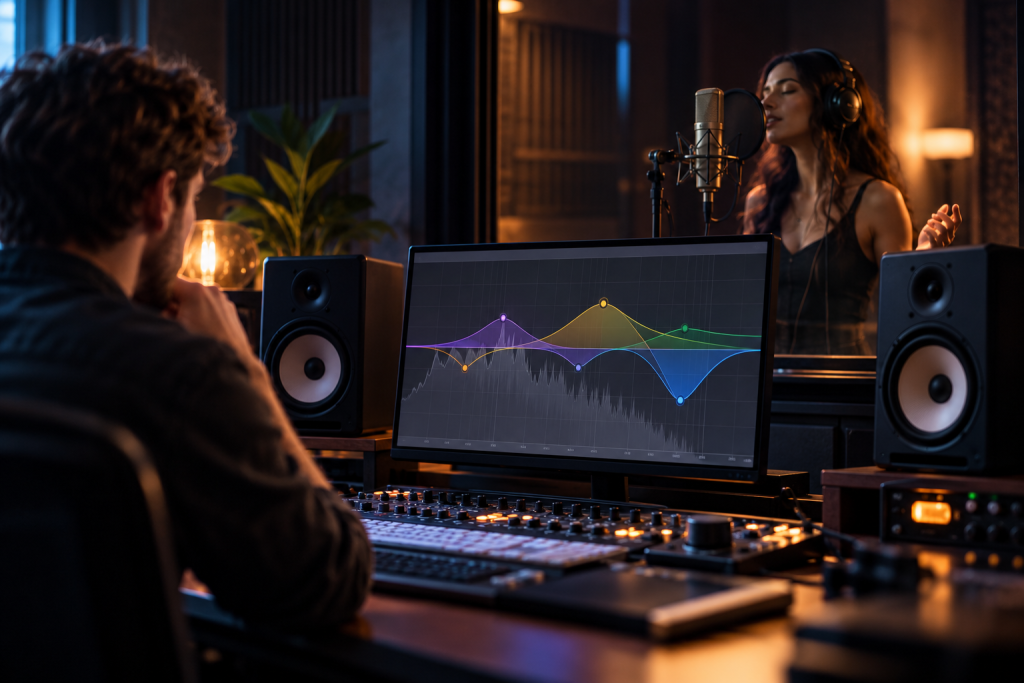
I pulled Pro-Q 4 into a vocal session the week it landed, on a song where the singer had one stubborn resonance around 300 Hz that kept jumping out on the louder lines. Normally I’d reach for Soothe 2 or a multiband compressor to chase it. This time I tried the new dynamic EQ bands on the lead and left the rest of the chain alone. Here’s how it went, and where I think dynamic EQ actually earns its keep on vocals.
What dynamic EQ is, and why it suits a voice
A dynamic EQ band only moves when the signal crosses a threshold at that frequency. It’s the same idea as TDR Nova, which lets each band react to the incoming signal and apply EQ only when certain frequencies cross a threshold. As one roundup puts it, that’s enormously useful for transparent vocal processing and for taming resonances without killing the character.
That last part is the whole point on a lead vocal. A static cut at 300 Hz removes that frequency on every syllable, including the quiet, breathy ones where it wasn’t a problem. A dynamic band just sits there, waiting for the loud take to trip it, then gets out of the way. The voice keeps its body on the soft lines and only gets corrected when it needs correcting.
If you’ve worked with a dynamic EQ before, Pro-Q 4’s version of it will feel familiar. What matters more is how you set it up for a singer.
Setting up a dynamic band without strangling the take
Find the resonance by listening, not by staring
Sweep a narrow boost, Q of 3 or higher as a common rule of thumb for surgical cuts, until the ugliest part of the voice jumps out. Then flip that band to dynamic mode and set it to cut instead of boost. I usually aim for 2 to 4 dB of reduction at most. More than that and the singer starts to sound like they’re singing behind a door.
Watch the attack and release
This is where most people get it wrong. A fast attack will catch the first transient of a hard consonant and clamp down ahead of the actual resonance. Back the attack off a few milliseconds until the reduction lands on the vowel, not the onset. Release wants to be slow enough that the band doesn’t pump in and out syllable by syllable, which you’ll hear as a little wobble in the tone.
Use the display to stay honest
I keep the detection display open while I set the threshold. If the band is reacting on nearly every word, the threshold is too low and I’m effectively running a static cut with extra steps. If it only lights up on the two or three problem lines, that’s the sweet spot.
Where I actually use it on a lead vocal
Three spots, in order of how often I reach for it.
- Boxiness and low-mid buildup around 200 to 400 Hz. This is the big one. Singers lean into these frequencies when they push, and a dynamic cut keeps the push while losing the mud.
- Harsh upper mids around 2 to 4 kHz on belted notes. The band stays dormant on verses and only engages when the chorus arrives.
- Sibilance, though I’d rather use a dedicated de-esser for this. A de-esser like the free Parish Audio S1 has a Range control that limits maximum reduction so the vocal doesn’t turn dull or lispy, plus a Monitor function to hear exactly what’s being removed. Pro-Q 4 can do a passable de-ess in a pinch, but I keep that job separate.
One thing it will not fix: a resonance that’s baked into the room or the mic choice. If the booth has a standing wave, you’ll be chasing it with EQ forever. Treat the space first.
How it fits against the rest of the chain
I run dynamic EQ early, right after the cleaning EQ and before compression. The reason is simple. If I compress first, the compressor reacts to the boom, the mud and the harshness and pulls the whole voice down around them. Clean those out dynamically first and the compressor sees a more even signal, so it works less and breathes more.
Then, if I still want a bit of air on top, a gentle static shelf around 10 to 12 kHz comes later in the chain, purely for color. That tonal EQ stage is about making the voice sound pleasant, not solving problems. The dynamic bands handled the problems.
One honest gripe. Dynamic EQ is seductive, and you can end up with five bands all doing a little something and the vocal sounding veiled because nothing is fully present. I’ve done it. Now I cap myself at two or three dynamic bands on a lead and leave the rest static. If I need more than that, the issue is usually the performance or the mic, not the frequency balance.
Versus Soothe 2 and multiband compression
Soothe 2 is a different animal. It attenuates frequencies dynamically based on the incoming signal across the whole spectrum, and it catches harshness and sibilance in a way a handful of EQ bands can’t. It’s my go-to for taming aggressive upper mids before saturation, so I’m not making them more audible. But it’s a broad safety net. Pro-Q 4 is a scalpel. When I know exactly which frequency is bothering me, I want the EQ. When I want something to smooth the whole top end without me pinpointing anything, I reach for Soothe.
Multiband compression sits between the two. It can tame a band, but it also changes the level of that band over time, which is more than I usually want on a lead. Dynamic EQ changes gain at a frequency only when triggered, and leaves everything around it untouched. On a delicate vocal, that’s usually the gentler move.
Is the dynamic EQ worth it if you already have Nova?
If TDR Nova is already in your chain and doing the job, you have a legitimate dynamic EQ that many engineers prefer to paid tools. The honest answer is that Pro-Q 4’s dynamic bands won’t transform a vocal that Nova was already handling fine. What you’re buying is workflow, the interface, and how the whole thing sits in a session you run every day.
Where it changed my process is speed. Getting the detection display and the band responding in the same window, on a singer who’s waiting in the booth, saves real minutes. In a client session those minutes matter. In my own demos, honestly, Nova would have done the same work.
So the verdict from the booth: the dynamic EQ is a genuine step up for lead vocal work, most useful on low-mid buildup and harsh upper mids, and best used sparingly. Two or three bands, set by ear, triggered only when the voice actually needs it. That’s the whole trick. The plugin doesn’t make the singer better. It just stops you from flattening the parts of the take that were already good.