Getting a Nervous Singer Comfortable in the Booth: 7 Things That Actually Work
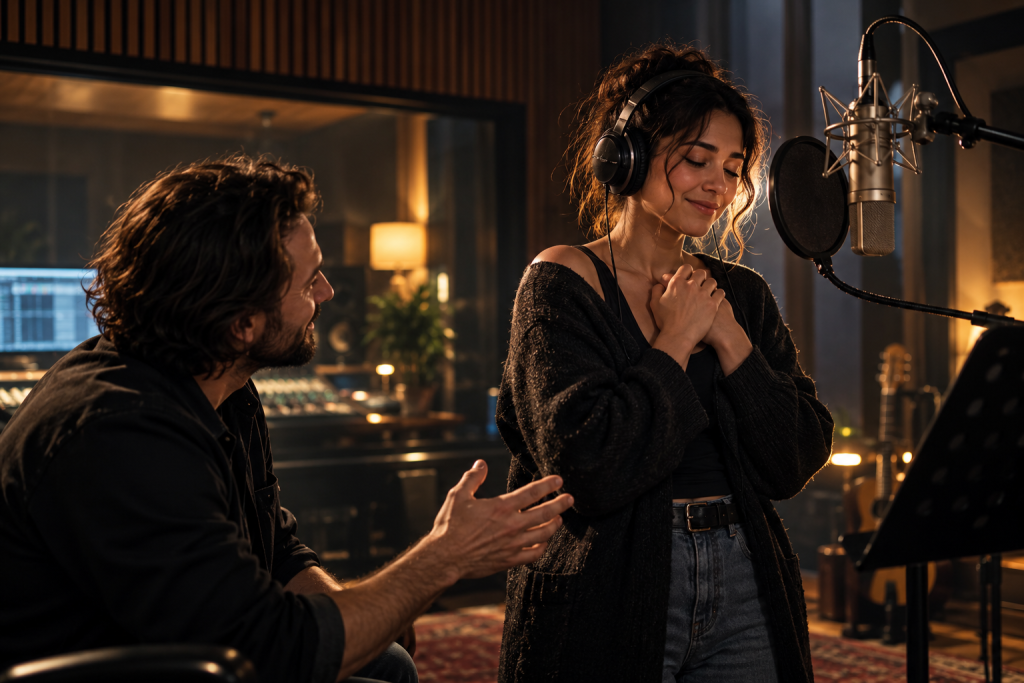
The singer is on the other side of the glass. Take three was great, take four was worse, and now she is apologizing before every pass. Nothing about her voice changed. What changed is that she is thinking about the microphone instead of the song, and I can hear that in every phrase.
I record singers in a small treated booth for a living, and how they feel in that room is a production parameter like gain or distance. A nervous take is a quiet take, a breathy take, a take with the jaw locked and the shoulders up. You can fix pitch later. You cannot easily fix a performer who has gone self-conscious.
These are the seven things that actually work in my sessions. None of them involve telling anyone to relax.
1. Do a “pretend” pass that nobody keeps
The hardest take is always the first one, because the singer assumes it is being judged. So I take that take away. I tell them the first pass is a “level check,” we may not even record it, I only need to hear where the mic wants the gain. Then I record it anyway.
Pressure drops the moment the take “doesn’t count.” Singers breathe, they warm up, they stop sight-reading the lyric sheet. Keep it in the session folder. Half the time a phrase from the throwaway take ends up in the comp.
2. Set the gain before they walk in, then leave the knob alone
Reaching for the gain knob mid-song reads as “problem” to someone already nervous. They hear the click, watch your hand, and start second-guessing their own dynamics. So I estimate the setting ahead of time and commit to it.
If the room is quiet and the chain is clean, peaks around -6 dB give me plenty of headroom. I would rather have a quieter, honest performance and normalize later than spook the singer with the fader every 20 seconds.
And say it out loud: “You’ll see me sit still and not touch anything. That means it sounds right.” Reassurance delivered as technical fact lands better than reassurance delivered as a compliment.
3. Sing with them, badly, on the quiet parts
This one embarrasses some engineers. Do it anyway. When a singer is holding back in a big chorus, I will sing a low harmony line from the control room, or just mouth the words and conduct. It gives them something to lean on, and my terrible voice makes the whole thing feel less precious.
Better still, give them a real guide. If I have a rough vocal or even a keyboard line doubling their melody, the singer stops feeling airy and alone. The context fills in the confidence. The track should carry a shy performance until the performer finds their footing.
4. Break the song into phrases they can win
Asking a nervous singer to “do the whole verse again” invites them to fail at the same spot as a unit. Asking them to nail four words gives them a shot at a small victory.
I comp in small chunks from the start, so the session is built around phrase-by-phrase wins. If the second half of the bridge keeps cracking, we work that line in isolation until it feels easy, then I play the full verse back with that fix already in it. Hearing your own improvement in context does more for confidence than any pep talk.
5. Leave the processing off their headphones
Some singers need a little reverb in their cans, since dry vocals can feel like singing naked, so I keep a tasteful room verb on the monitor path only. What I do not do is drop a compressor or a tuner on the headphone mix and let them hear it.
A hard-tuned or heavily squeezed vocal in the cans teaches a singer to trust the software instead of their own placement and pitch. The dry voice is what they need to hear while they work. The polished version, compression, de-essing, and any tuning, belongs later in the workflow, not mid-session on the headphone feed. I have watched singers chase their own unprocessed tone for an hour because someone put something clever on the cue instead of capturing a clean take.
6. Kill the visible clock
Time pressure is the silent confidence killer. If the singer can see a countdown, an hourly rate ticking, or the producer pacing behind the glass, they will rush. I hide my session timer, and if the budget is tight I negotiate it in the kitchen before the session and never mention it in the booth.
This is where I am stubborn about studio time as an investment in the performance rather than a rental for equipment. The cost of an extra hour to nail the vocal is almost always less than the cost of comping a panicked take.
7. Know when to call the take
I used to let singers keep going until the voice went flat and the mood went with it. Not anymore. When I hear the tone thin out and the phrasing get short, or when the “sorry” starts again, I stop the tape and say we got it.
And I mean it. If the comp will hold, it will hold. Overworking a nervous singer is where a good vocal goes bad, and where you can hear the anxiety on the final mix years later. Tension creates a resolution, and that applies to a session just as much as a chord progression: the singer needs to feel the session end on a win.
A quick word on the room
Half of booth confidence is acoustic. A treated space with low reflections lets a singer hear themselves through the headphones rather than through the walls. And a clean, dry room also means my later moves are simple: a gentle EQ to tame any harsh high mids, a light de-ess so the “Ss” do not draw attention, and modest compression. I do not need to fix a frightened performance with plugins. I just need to stop creating one.
The best take is rarely the most polished one. It is the one where the singer forgot they were being recorded. Every one of these seven moves aims at that same small goal: get the performer out of their head and back into the song.