FabFilter Pro-Q 4 Is Here: What the Update Means for Vocal Mixers
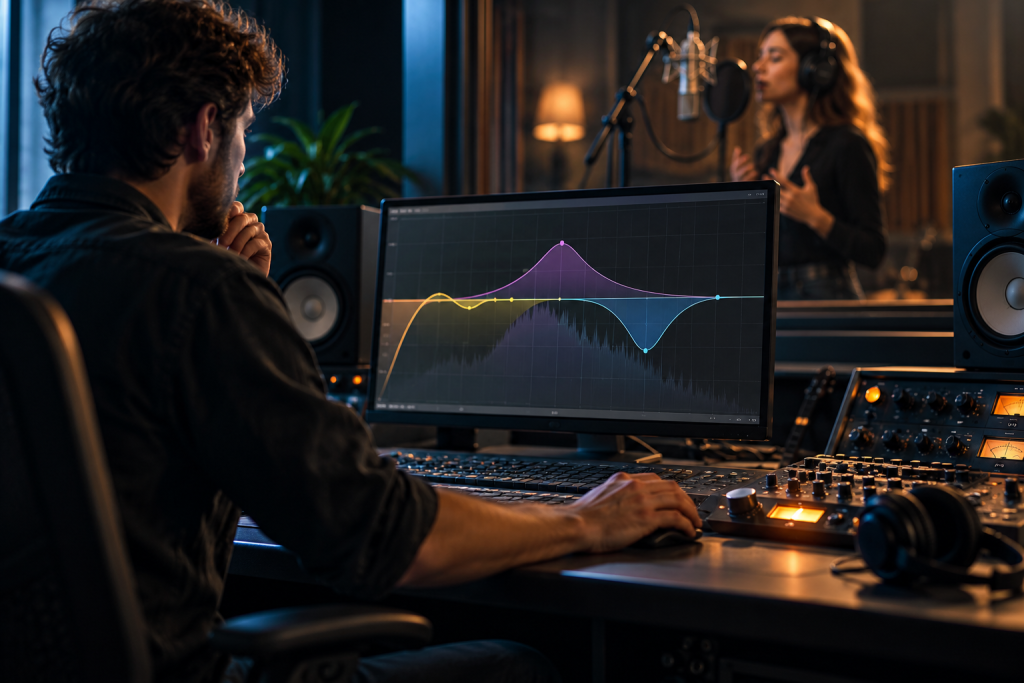
I have not had Pro-Q 4 in a session yet, and I want to be honest about that up front. But I have mixed enough lead vocals through Pro-Q 3 to know exactly which parts of my workflow I would want changed, and the early picture of the update lands right on a few of those sore spots. So let me talk practically about what a new Pro-Q means for someone sitting in a treated booth with a nervous singer and a pile of comps.
Where Pro-Q 3 sat in my vocal chain
For the uninitiated, Pro-Q 3 has been the default corrective EQ on almost every vocal I track. The reason is boring and important: it is fast, the interface stays out of the way, and the dynamic bands let me tame a honky vowel or a resonant note without carving a static hole in the singer’s tone.
On a lead vocal I typically run EQ before compression, and the advice I give singers who record themselves mirrors what you see in good mastering chains: make narrow cuts, Q of 3 or higher, so you do not scar the neighboring frequencies. Broad boosts live later in the chain, or on a parallel copy. Pro-Q 3 does the surgery part beautifully. It was never the weak link.
What it was not great at, for me, was the stuff around the EQ. Dynamic bands are wonderful until you have six of them active and you cannot remember which one is clamping the 3 kHz region during the chorus. Finding a specific moving band, or comparing two vocal takes through the same EQ, always meant some clicking around.
What a vocal mixer actually needs from an EQ update
Here is my wish list, built from real takes. I want dynamic EQ that behaves more predictably on breathy consonants and nasal resonances. I want easier A/B between processed and unprocessed so I can check I am not overcorrecting. I want the analyzer to tell me something useful about the singer in front of me, not just a pretty curve. And I want less mouse travel when a session is moving fast.
Those are the things that save a vocal. A new filter shape matters less to me than whether I can find and grab the band that is dulling a phrase. If Pro-Q 4 tightens the workflow around dynamic bands and comparison, that is a win for vocal work specifically.
The dynamic-processing context
Worth remembering while we wait on details: EQ and dynamics are not separate jobs in vocal mixing. A dynamic EQ band that gently controls excessive brightness can do a light de-essing job, and many engineers already lean on it that way. The better your EQ handles frequency-selective movement, the less you reach for a dedicated de-esser on some takes.
That does not mean Pro-Q replaces a de-esser with a dedicated monitor or range control. Tools built for sibilance have their own appeal precisely because they limit how much reduction happens, so a harsh consonant cannot turn the vocal dull or lispy. The strong de-essers also let you audition only the removed signal, which is the fastest sanity check there is. A dynamic EQ band is a blunt instrument for that job. Treat Pro-Q as the tone-shaping layer and keep a purpose-built de-esser nearby.
The same logic applies to saturation and character. Pro-Q 4 should stay clean where it needs to, and you bring in analog-style color afterward if the vocal wants it. Do not ask one plugin to be the whole chain.
How I would audition Pro-Q 4 on a real vocal
When the update lands in my booth, the test is not a demo track. It is a raw comp of a real singer. My order of operations:
- Load the same vocal I mixed last week in Pro-Q 3 and try to rebuild the EQ moves from memory. If the new interface makes that faster, good. If it makes me hunt, that is a problem.
- Check the analyzer against a singer with a strong nasal resonance. Does it help me spot the problem, or just show me numbers?
- Set up two or three dynamic bands on a breathy passage and confirm they behave the way I expect at the settings I actually use.
- A/B processed versus bypass on a phrase I know well. Anything that makes that comparison instant earns its place.
If those four things hold up, Pro-Q 4 stays in the chain. If they do not, Pro-Q 3 does not suddenly stop working, and neither do I have to upgrade on day one.
The honest verdict, for now
I am cautious about launch-week enthusiasm. A new version of a tool this widely used will get a wave of “best EQ ever” posts, and most of them will not have tracked a nervous singer at 10pm. My advice is the same one I give singers about microphones: do not buy the upgrade because it is new. Buy it if it removes a specific annoyance from your session.
For vocal mixers, the value of Pro-Q 4 lives or dies on whether the day-to-day handling of dynamic bands, comparison, and analysis got better. The EQ sound is already good. It is the hands-on part that determines whether this update matters to the person comping a lead vocal. I will know more once it is under my mouse in a real take. Until then, treat the hype accordingly and keep your current chain running.