Stop Singing Into the Mic: A Simple Distance Drill for Better Takes
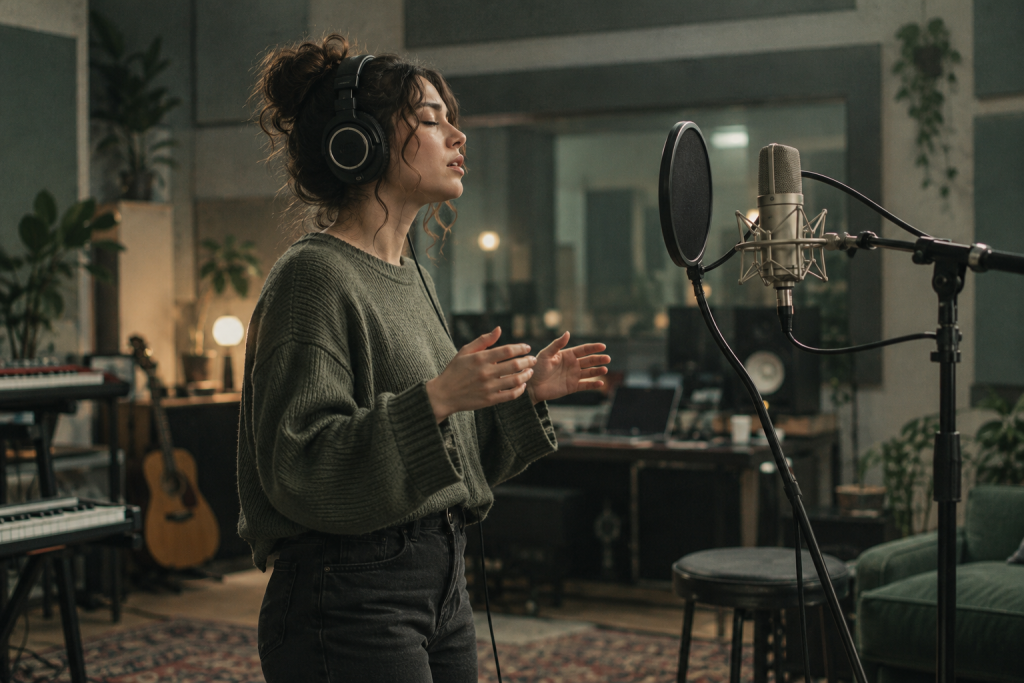
Most singers I record stand too far from the mic. Then they lean in for the loud note and back away for the quiet one. By the end of the take the vocal is a rollercoaster of proximity effect and level, and no compressor setting will fix it cleanly.
Here is the drill I use to break that habit in about ten minutes. No plugin, no gear, just a singer, a mic, and a bit of tape on the floor.
Why distance matters more than the mic
Before any of that, a quick reframe for the singer. The distance between their mouth and the grille changes two things at once: how loud the signal hits the preamp, and how much bass the mic picks up from being close. Move in and the tone gets heavier and louder. Move out and it thins and drops in level. That is physics, not preference, and it happens on a $100 mic and a $3000 one alike.
So the goal of the drill is consistency. The singer learns to hold a distance that gives them a stable tone and level, then sings the whole part from there instead of chasing volume with their feet. Any mixing engineer will tell you a steady take is worth far more than a dramatic one, because the compressor has something predictable to work with.
The tape-on-the-floor method
I keep a roll of masking tape in the booth. Here is how I run it.
- Set the mic at a fixed height and angle. Nose height, tilted slightly down toward the mouth, or straight on depending on the voice. Lock it and leave it.
- Find the working distance. I have them stand with a relaxed arm’s length to the grille, roughly the length of a forearm or a bit more. Not kissing the pop filter, not a step back either.
- Tape their feet. Two strips at the heels and toes so the stance is repeatable. Now moving closer to the mic means deliberately breaking the stance.
- Mark the mouth distance with a pop filter. Set the pop filter so it sits between the singer and the grille at a distance that keeps them honest. If their lips touch it, they are too close.
That last one is the real trick. A pop filter at the right distance does double duty: it kills plosives and it gives the singer a physical cue for where their mouth belongs. When they lean in for the big note, the filter stops them. When they drift back, they feel the gap.
Run the dynamic test
Once they are set, I ask for one phrase at three volumes. Quiet, medium, loud. Same phrase each time, standing in the same spot. I record all three and play them back.
Nine times out of ten the loud one peaks too hot because the singer unconsciously pushed toward the mic, or the quiet one is buried because they pulled away. Hearing it back is the teaching moment. I do not explain it, I just let the playback do the work.
Then we run it again with one rule: feet stay planted, the body does not move toward or away from the mic, and volume changes come from breath support instead of from the legs. I might nudge the mic height or angle between passes if the tone is off, but the distance stays constant.
Set input gain so the loudest pass peaks around minus 6 dB. That leaves headroom for a performance that gets more excited than the rehearsal, and it keeps the preamp out of trouble. If a singer peaks way below that on the quiet pass, that is fine. Dynamics are the point.
The proximity trade-off
Now, some singers want that close, intimate, bass-heavy sound. That is legitimate. The trick is to make it a choice instead of an accident. I will tape them close to the filter for a soft, breathy verse if the song calls for it, then move them back for the chorus so the loud part has room to bloom without clipping the preamp.
The mistake is letting proximity effect happen randomly. A singer who rides the mic produces a take where some words are boomy and some are thin, and the mixer spends an hour trying to smooth it out with automation. Ten minutes of distance work on the front end saves that hour on the back end.
Recording doubles and harmonies with the drill
This matters even more when you are stacking. The whole value of a double comes from two takes that are close but not identical. Timing, pitch, and expression wobble naturally. If the singer also wobbles in distance between takes, the tone shifts too, and the stacked vocal turns into a muddy mess instead of that wide, dimensional sound.
So I run the drill once, tape the floor, and then every double and harmony happens from the same mark. When a singer asks to move for the harmony part, I say no and move the mic instead, or just let them sing from the mark. Predictable distance is what lets the doubles blend.
For the harmony stack, I keep the same working distance for every pass. The lead might sit a touch closer for intimacy, but the doubles and harmonies stay put. That consistency is half the reason a stack sits together with a little panning and a shared reverb.
What to do when the singer still moves
Some singers are physical. They gesture, they sway, they lean into the emotional line no matter what. That is a real performance and you do not want to kill it.
Here is what I do in that case. First, I let them move but I keep the mic at a distance that gives them room, so a small lean does not wreck the level. Second, I ask them to move their upper body but keep the feet on the tape, which limits the drift. Third, I accept a little movement and plan to even out the level in the mix, because performance beats precision every time.
There is one hard rule though. If they are pointing the mic at a speaker or moving it toward a monitor, stop them. Feedback is not a tone choice, it is a ruined session. Keep the mic away from the speakers and the singer facing the right direction, and the drill will hold.
The one thing to take away
Distance is a skill the singer can learn in a single session, and it costs nothing to teach. Tape the floor, set the filter at a working distance, run the quiet-medium-loud test, and let them hear the playback. Once the feet are planted and the volume comes from breath instead of from leaning, the takes come out steadier, the tone stays even, and whatever processing you do later has a clean, predictable signal to sit on.
The mic does not need to be expensive. The singer just needs to stop chasing it.