Five Budget Condenser Mics That Hold Up on Lead Vocals
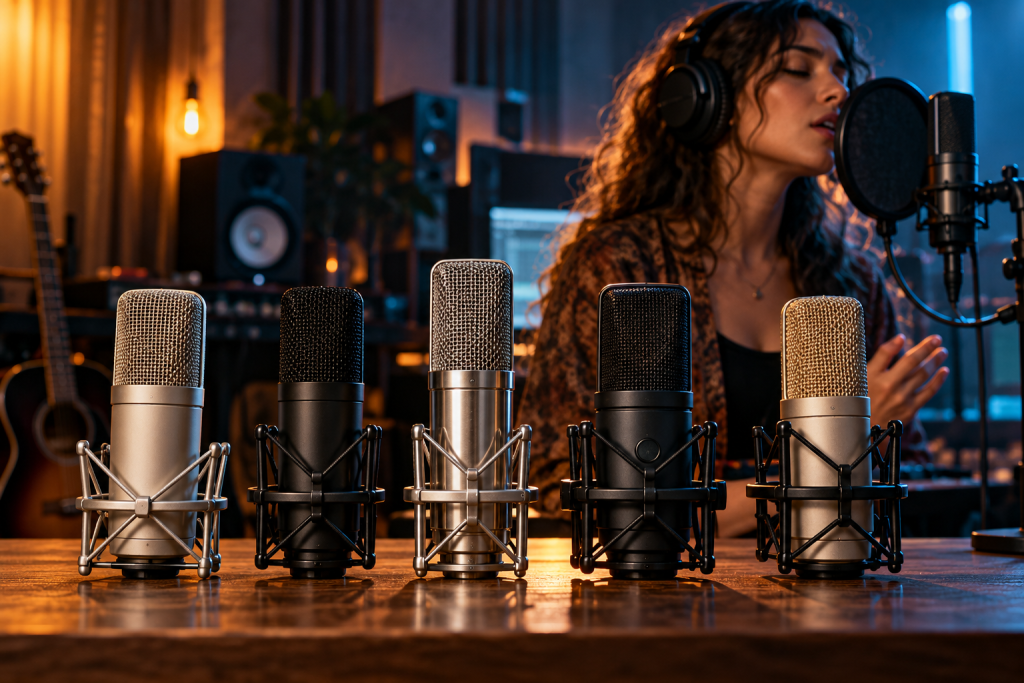
I’ve tracked lead vocals through everything from a borrowed SM7B to a $4,000 tube condenser, and the mics I reach for most in my own booth are the ones that cost less than a decent preamp. Budget condensers used to be a joke. A decade ago, “entry level” meant a brittle top end and a self-noise floor you could hear breathing between phrases. That’s changed. The stuff coming out of China and the better budget lines from established brands now holds up on real sessions, as long as you pick the right one for the voice in front of you.
What follows are five condensers I’ve actually used on lead vocals, with the honest caveats. Before any of that, one idea that shapes everything else here: your microphone does more to the raw sound than any plugin chain downstream of it. The folks at Major Mixing put it bluntly, saying 90% of vocal quality comes from the mic and the rest is mixing, and that “a bad-sounding mic can’t be fixed later, no matter how good the plugins are.” I’ve found that true. A cheap mic through a great interface still sounds cheap. A good mic through a modest interface sounds good.
The shortlist, and what each one is for
None of these is a universal “best.” Each has a character, and the point is matching character to voice. The most useful advice I can pass on is the approach Major Mixing recommends: build a shortlist with real contrast (one clean and detailed, one bright with air up top, one darker and heavier in the low mids) and record the same phrase through each at matched level. Specs won’t tell you which flatters a given singer. Your ears will, once you hear them in a mix and not soloed.
Audio-Technica AT2020
The default first condenser for good reason. Cardioid, large-diaphragm, fixed pattern, and built like it’ll survive being knocked off a stand. On a bright, reedy voice it can get harsh, but on a darker or chesty singer it’s genuinely usable as a lead mic. It’s also the cheapest thing on this list, which matters if you’re still deciding whether home recording is for you. The limitation is self-noise and a slightly thin low end on quieter, breathier performances. Track it close and it’s fine. Whisper five inches back and you’ll hear the floor.
Rode NT1 (the newer black one)
Rode’s current NT1 has one of the lowest self-noise figures you’ll find in this price bracket, and that’s the whole pitch. If you record soft singers, intimate ballads, or anything where you want to crank gain without hiss, this is the one. It’s also remarkably neutral, which is a polite way of saying it has little personality of its own. That’s a strength when you’re the one mixing, because you’re not fighting the mic’s color. It’s a weakness if you wanted a mic to do half the tonal work for you. Pair it with a pop filter 30cm out and decent gain staging and it just gets out of the way.
Aston Spirit
A more colored option. It has a bit of presence lift and a fuller low mid than the Rode, which flatters thinner voices and gives a pop or rock lead some body without EQ. I’ve used it on singers who sound small on a neutral mic and suddenly sound like themselves on this one. It’s heavier and the shock mount is fiddlier than I’d like, but the tone earns its place on the shelf. Good contrast pick against the NT1.
Shure KSM32
This one stretches the word “budget,” but it belongs here because it’s the step up that actually sounds like a step up. It’s a side-address condenser, cardioid, and it handles a loud, dynamic singer without the top end turning to glass the way cheaper bright mics do. On belted choruses it stays composed. If you’re recording a rock or theater voice that pushes hard, this is where I’d put the money. It’s also the most expensive pick, so if budget is tight, skip it and put the difference into treating your room, which will change your recordings more than any mic upgrade.
Warm Audio WA-47jr
A large-diaphragm condenser voiced toward the vintage, darker, thicker end. On a sibilant or bright singer, this tames the top in a way plugins can’t quite fake. On an already-dark voice it can get muddy, so it’s the most voice-dependent mic here. Multichannel pattern options make it flexible for other sources too. I reach for it when a singer needs warmth and weight more than detail.
What I’d actually do with this list
Don’t buy blind. If you can, rent or borrow two or three of these and run the test Major Mixing lays out: one pop filter at 30cm, gain peaks no higher than -6dB, and record a chorus lead plus two doubles and two harmonies, about 20 seconds per mic. Then drop all the takes into one session and listen in context, with EQ and compression on. That last part matters. Some budget mics sound fine raw and fall apart once you compress them and stack layers. Others sound ordinary soloed and sit beautifully in a mix. You only hear the difference when you process them.
The other thing I keep coming back to: the room. In an untreated space, treatment changes your recording more than a new mic will, and Major Mixing’s own guidance is to budget for the room as well as the mic. If your booth is a bare bedroom, a tighter dynamic might serve you better than any condenser on this list, because it rejects the reflections a condenser will happily capture. Buy the condenser when you’ve got something absorbent behind the singer.
One honest recommendation against buying: if you already own a clean interface and a treated space and you’re choosing between a $200 condenser and a $400 one, don’t assume the $400 is twice as good. Spend an hour with both on your own voice first. The winner isn’t always the more expensive box, and it’s never the one the spec sheet picked for you.