Comping Vocals Without Flattening the Performance: My Workflow
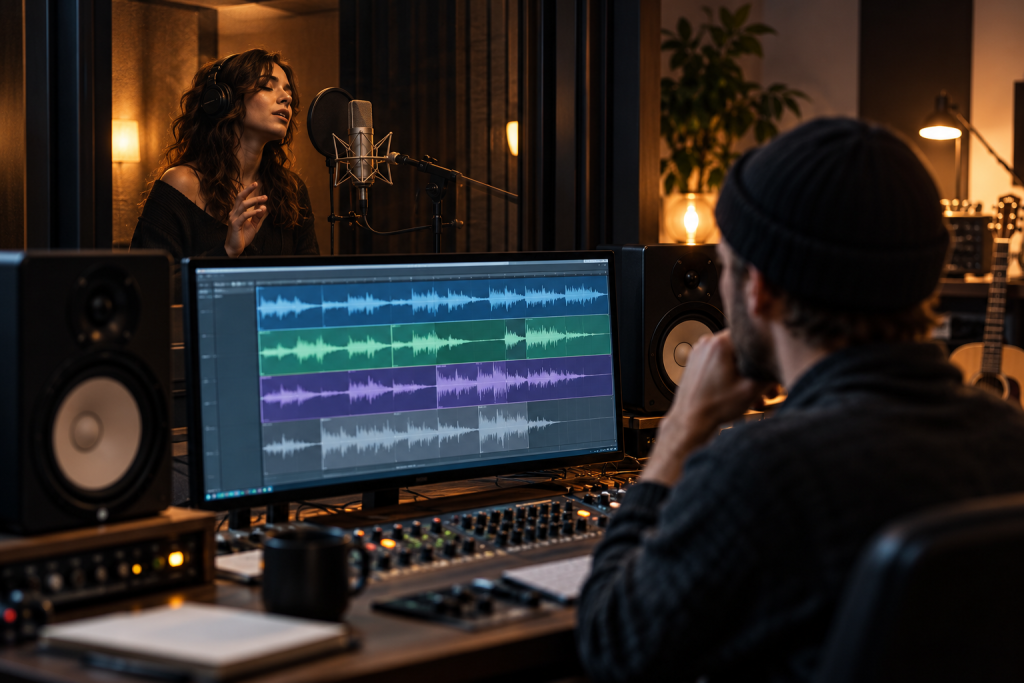
I keep hearing comped vocals that sound like a machine assembled them. Every syllable sits at the same level, every breath is trimmed to the millisecond, and the singer’s face has been sanded off. It’s clean. It’s also dead.
Comping is the art of building one lead vocal from several takes, and the whole job is choosing which performance survives. If you make every choice for the sake of perfection, you flatten the thing you were trying to protect. Here’s how I work a comp session without stripping the life out of it.
Pass the takes, but listen for character first
Before I even open a DAW, I listen to the raw takes on headphones with no grid and no processing. No comping, no tuning, nothing. I want to hear where the singer’s energy went up, not just where the pitch landed.
A take that’s technically clean but emotionally flat is a lose for the lead. I’ll take a slightly rough take with a cracked edge over a sterile one, every time. The imperfections are the point, not the problem.
I mark three things per take: the phrase that moved me, the phrase that’s technically strongest, and any identifiable breath where the singer was truly singing, not just making mouth sounds. Those breath markers are gold later. They tell me where a phrase begins emotionally.
The comp grid is a trap if you follow it blindly
Yes, I cut in phrase chunks. Whole words and whole breath units. But I leave the cuts where the singer actually paused, not where the metronome told me.
When you slice mid-breath to grab a “better” note, you break the connection between the inhale and the note it supports. Singers breathe as part of the phrase. Cut there and the note sounds like it arrived from nowhere.
My rule: if I have to cut inside a breath, I stitch the breath back in from the same take, or I punch it. Otherwise I don’t make the cut.
Keep the breaths you want and delete the rest
Some engineers nuke every breath. I don’t. Breaths are rhythm, and they’re intimacy. A well-placed audible inhale before a big line tells the listener the singer is about to commit.
What I do trim out are the nervous, shallow, empty breaths that don’t support anything. The difference between a breath that serves the phrase and one that’s just the mouth doing maintenance is usually obvious on a second listen.
If a breath is too hot, I’ll ride it down a few dB rather than cut it. That keeps the air in the room without the gasp stealing focus.
Pitch correction: correct what wanders, not what’s expressive
This is where most flattening happens. Pitch correction in full auto-across-the-board mode will iron out every intentional glide and blues curl and turn a living singer into a theremin.
I work section by section and leave micro-slides alone unless they’re an accident. A deliberate fall off a note is the singer’s voice. A slightly flat sustain is a mistake. Learn to hear the difference before you grab the pencil tool.
If a phrase is genuinely out but the performance is great, I’ll tune the phrase and then check it in context, not solo. What sounds corrected alone often sounds corrected-and-wrong in the full mix. Context is the truth serum.
Doubles and stacks belong to the chorus, not the verse
When I want a chorus to open up, I reach for a proper second pass, not a duplicated and nudged copy of the lead. Copying the same take and shifting it a few milliseconds just makes it louder and phasey.
A real double brings width, depth, and a human wobble that a copy cannot produce. The small timing and pitch differences between two genuinely sung takes are what make the stack feel alive rather than synthetic.
I tuck the double under the lead and ride the blend per section. Verses stay mostly single. Choruses get the double plus a harmony or two, panned out, sitting back. The lead stays centered and readable.
Compression after the comp, not instead of it
A lot of flattened vocals are a comping problem disguised as a compression problem. If you lean on a compressor to even out a sloppy comp, you’re asking a plugin to do editorial work. It can’t, and it will clamp down on the expressive parts while masking the lazy parts.
I get the comp as consistent as I can with fader moves, then reach for something transparent. FabFilter Pro-C 2 is my default for lead vocals precisely because it controls dynamics without changing the timbre. My favorite thing about it is the Audition Triggering, which lets me hear exactly what the compressor is grabbing. If it’s grabbing the emotional peaks instead of the unwanted peaks, I’ve set it wrong.
For a denser, more glued sound I’ll run something with a little character, like an opto-style compressor in a warm mode, medium attack and release, letting some harmonics through. That’s glue, not surgery.
Watch the harshness. Pro-C 2’s vocal presets push the lead forward, but on acoustic material I’ve found they can introduce a bit of edge. Back off to a cleaner style and only then add the push.
Clean the comp before you mix it
Once the comp is chosen, I do a surgical pass: de-ess, tame any harsh resonances, and only then start tone-shaping. Soothe 2 is my tool for dynamically catching sibilance and aggressive upper-mid buildup without carving out unrelated frequencies the way a multiband might.
That cleanup happens before saturation or distortion, so I’m not amplifying the rough edges I’m about to fight. Get the comp clean, then color it. Never the other way around.
Leave the rough edges that belong to the take
The final call on every comp is whether the thing sounds like one performance or a committee of takes. If a crack, a plosive, or a slightly flat note is part of how the singer felt that line, I leave it.
I’m not chasing perfection. I’m chasing a take the listener believes. Comp ruthlessly for rhythm and pitch where it matters, and protect the human moments everywhere else. That balance is the whole job.
If you walk out of a comp session and the vocal sounds a little less perfect than the raw takes but a lot more like a person, you did it right.